AI Content Factory
Automated video production pipeline based on multiple orchestrated generative AI models.
From briefing to finished video clips: specialized AI models for text, image and video generation are combined into an automated, controllable production process.
- Technical challenge
- Multiple specialized generative AI models were to be orchestrated into an automated, repeatable video production process – instead of operating models individually and manually.
- Architecture
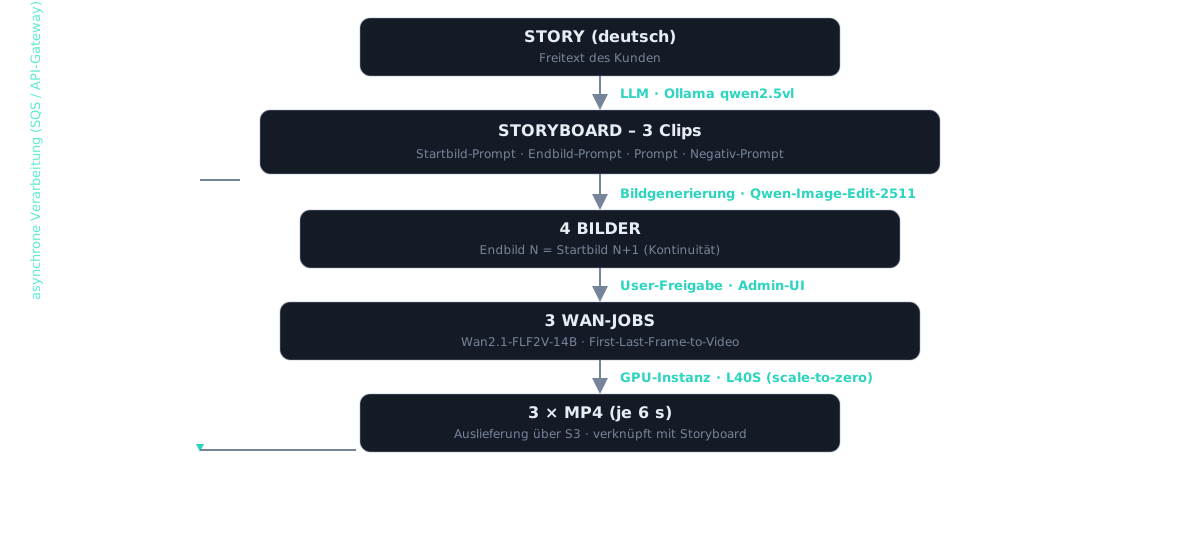
- A German story is broken down by an LLM (Ollama qwen2.5vl) into a storyboard of three clips; an image model (Qwen-Image-Edit) generates start/end images with consistent continuity, and a first-last-frame-to-video model (Wan2.1-FLF2V-14B) generates the clips on a GPU instance.
- Engineering challenges
- Consistent characters across the clips (end image N = start image N+1), asynchronous processing despite long LLM runtimes, scale-to-zero GPU operation and orchestration via SQS instead of synchronous API calls.
- Demonstrated capabilities
- Generative AI, model orchestration, workflow automation and production pipelines with an asynchronous job model and GPU operation.
The AI Content Factory (Storyboard Generator) is a Riegel Systems engineering case in the field of generative AI. The core idea: multiple specialized AI models are not “operated” individually, but orchestrated into an automated production pipeline.
The pipeline
- Briefing
- Storyboard
- Scene Planning
- Start Image
- End Image
- Video Prompt
- Image-to-Video
- Final Clips
Implemented in practice
A storyboard of three 6-second clips is generated automatically from a German story:
- Story → Storyboard: An LLM (Ollama
qwen2.5vl) breaks the story down into three scenes and generates, per clip, a start-image prompt, end-image prompt, motion prompt and negative prompt – as strict, schema-validated JSON. - Image generation: An image-editing model (
Qwen-Image-Edit-2511, Apache-2.0) generates the four images with consistent continuity – the end image of one clip is also the start image of the next. - Image-to-video: A first-last-frame-to-video model (
Wan2.1-FLF2V-14B) generates the final clips from start image, end image and prompt on a GPU instance (L40S) with scale-to-zero. - Approval workflow: The previews are reviewed and edited in an admin UI before the video jobs are triggered.
Engineering focus
- Model orchestration: Each model takes on the task it is best suited for – text analysis, image editing, video generation.
- Asynchronous job model: Long LLM and GPU runtimes are decoupled via SQS instead of being squeezed into restrictive API timeout windows.
- Prompt generation: Automatically generated, precise prompts drive the models deterministically instead of manually.
Key takeaway
Production-ready generative AI systems are systems integration: normalize inputs, validate outputs, handle failures and monitor costs. The Storyboard Generator shows how individual models become a reliable, repeatable production process.
Technologies & concepts
A similar engineering project?
If your project needs comparable technical depth, we discuss feasibility, architecture and effort – concretely rather than in pitch format.