
AI Process OS
An AI-native operating system for business processes – BPMN, natural language and a validated workflow runtime.
An AI-native operating system for business processes in which processes, capabilities, roles, events and tenants are central system elements. Natural language and BPMN yield validated, executable workflows.
- Technical challenge
- Business processes were to be describable in business terms – in natural language and BPMN – and automatically yield reliable, validated, executable process logic, without the AI generating uncontrolled code.
- Architecture
- A platform comprising BPMN editor, AI semantic layer, capability registry, workflow compiler and runtime on AWS: the LLM translates language into a structured intermediate representation, a compiler produces BPMN 2.0, and the runtime executes tasks, timers and events via registered capabilities.
- Engineering challenges
- Making AI results deterministic and safe: only execute registered capabilities, no direct database access, tenant isolation, auditability and process versioning via multi-stage validation.
- Demonstrated capabilities
- AI-native process automation, AI workflow engineering, BPMN-based process modeling, semantic analysis, multi-tenant architecture and a serverless AWS backend.
AI Process OS is a Riegel Systems engineering case in the field of AI-native business process engineering. The platform sees itself as an operating system for business processes: processes, capabilities, roles, events and tenants are first-class system elements – analogous to the programs, system APIs, permissions and isolated user environments of a classic operating system.
The core message:
AI produces structured and validated business logic instead of uncontrolled runtime code.
Pipeline
- Natural Language / BPMN
- Semantic Parsing
- Intermediate Representation
- Validation
- Workflow Compiler
- Workflow Runtime
- Domain Services
- Persistence / Events / Audit
Architecture
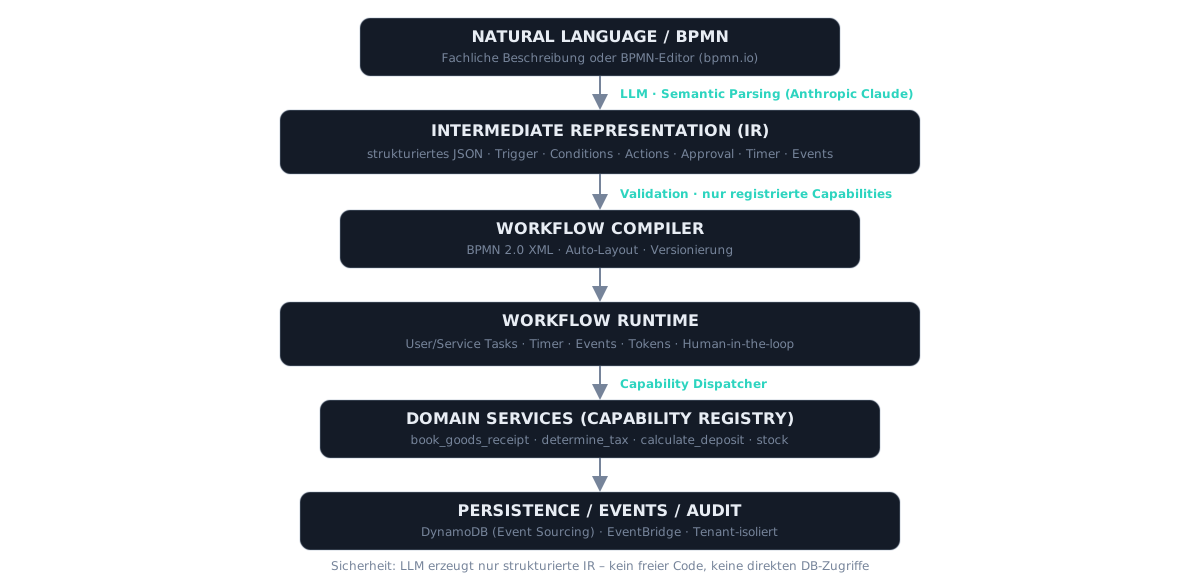
Semantic Layer
Business logic is described in business terms, not programmed:
- Natural language as input: An LLM (
claude-haiku-4-5) translates business instructions into a structured Intermediate Representation (IR) – as strict JSON with trigger, conditions, actions, approval, timer and events. - BPMN-based modeling: The BPMN editor (bpmn.io) is the primary visual interface; descriptions can additionally be generated as valid BPMN 2.0 XML (including auto-layout).
- Capability Registry: All system functions are registered and validated – e.g.
book_goods_receipt,determine_tax,calculate_depositand warehouse/accounting operations.
Validation as a security principle
The AI deliberately has no execution environment:
- The LLM produces only structured, schema-validated representations – no free code, no SQL, no direct database operations.
- Only registered capabilities may be used by workflows; during the parsing phase the semantic layer receives only the list of available capabilities.
- Missing capabilities can be proposed as a draft by the AI, but require review and activation before they can run in workflows.
- The workflow runtime executes tasks (user/service), timers, events and approvals via the capability dispatcher – with roles and permissions per tenant.
- LLM → structured IR only
- Validation → registered capabilities only
- Capability suggestion → Draft
- Review & activation
- Runtime execution
Runtime & Operations
- Workflow Compiler: The validated IR yields versioned process definitions (BPMN 2.0, auto-layout).
- Workflow Runtime: Process instances with tokens, human tasks, timers and events – including human-in-the-loop for approvals.
- Events & Audit: Events are logged; persistence uses event sourcing in DynamoDB (single-table design).
- Tenant Isolation: Multi-tenant runtime with tenant-scoped middleware and data encapsulation.
- Infrastructure: Fully as code (AWS CDK): Lambda, API Gateway, DynamoDB, Cognito, EventBridge, S3/CloudFront, GitHub Actions.
Capability demonstrated
AI Process OS demonstrates AI-native process engineering in which an LLM is embedded into a deterministic, validated execution path – including multi-tenant e-commerce as an integrated module (catalog, cart, checkout, payments, order management).
Technologies & concepts
A similar engineering project?
If your project needs comparable technical depth, we discuss feasibility, architecture and effort – concretely rather than in pitch format.