
Travel MCP
An MCP server for agentic price search across multiple travel portals – with hard safety boundaries.
A Model Context Protocol server that searches for package holidays across multiple portals and determines the final price before a binding action – safety first: no booking, no payment, no personal data.
- Technical challenge
- Agents need more than tool calling: they must work reliably and safely across multiple providers – determine prices right up to the binding booking without ever triggering a booking or disclosing personal data.
- Architecture
- An MCP server with a tool layer, provider abstraction and a safe browser layer (SafeBrowser): domain allowlist, BookingSafetyGuard, challenge/overlay/consent handlers and evidence recorder carry out the automation within clear action boundaries.
- Engineering challenges
- Production hardening of agentic systems: circuit breaker, rate limiting, concurrent-search control, selector-drift detection, semantic validation, session cleanup, freshness TTLs and defined price-confirmation levels.
- Demonstrated capabilities
- Model Context Protocol, agentic tool use, multi-provider systems, secure browser automation, safety boundaries, semantic validation and observability.
Travel MCP is a Riegel Systems engineering case in the field of agentic systems & MCP engineering. The travel use case serves as a concrete demonstrator for the technical requirements of production-ready agentic systems – not as a travel portal.
The core message:
Reliable agentic systems require more than tool calling.
Production-ready agent systems need safety boundaries, provider abstraction, semantic validation, observability and robust failure handling.
Architecture
- AI / MCP Client
- MCP Server
- Tool Layer
- Provider Abstraction
- Safe Browser Automation
- Travel Portals
- Validation / Evidence
- Normalized Results
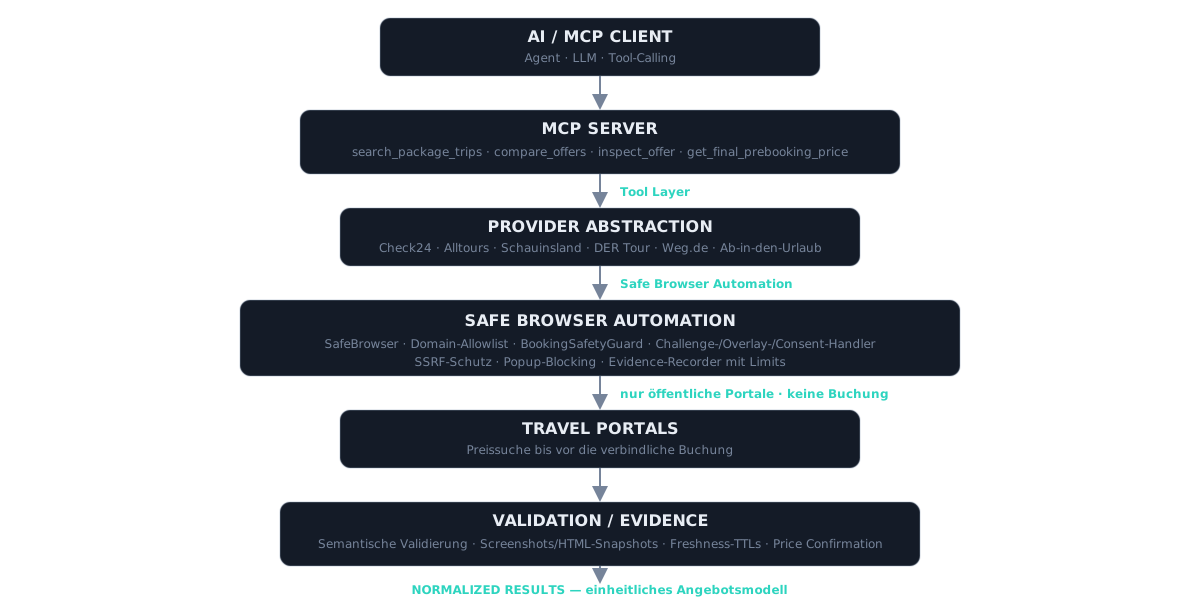
MCP Tools
Via the Model Context Protocol, the server provides the following tools, among others: search_package_trips, compare_offers, inspect_offer, get_final_prebooking_price, get_search_status and reset_session. The search runs across multiple providers in parallel; a normalized offer model delivers comparable results.
Safety Engineering
The central differentiator is the technical action boundaries:
- No binding booking – the automation consistently stops before the last binding action.
- No payment and no real personal data are transmitted.
- BookingSafetyGuard: Potentially binding actions are actively blocked – based on button texts (“Book now”, “Order with obligation to pay”, “Proceed to payment”, …), URL patterns (
/payment,/booking/confirm, …), form actions and HTML classes. - SafeBrowser: Domain allowlist per provider, SSRF protection (blocking of internal IPs in production), popup and new-tab blocking, blocking of
javascript:/data:/file:schemes. - No CAPTCHA bypass, no stealth or fingerprint evasion.
- Evidence Recorder with limits (screenshots, HTML snapshots, file/session sizes) and path traversal protection.
- no booking
- no payment
- no personal data
- Stop before binding actions
- Blocking of potentially binding actions
Production Hardening
Based on the real implementation:
- Circuit Breaker – opens after technical errors, half-open after cooldown, closes after success (non-technical errors such as
NO_RESULTSdo not affect the breaker). - Rate Limiting – conservative minimum intervals between requests (e.g. 5 s); exceeded requests are rejected with
RATE_LIMIT_EXCEEDED. - Concurrent Search Control – parallel searches per provider are blocked with
PROVIDER_BUSY. - Selector-drift detection and semantic validation of the extracted results.
- Challenge Detection (captcha/challenge detection), overlay handling and consent/cookie dialog handling.
- Session Cleanup and freshness TTLs for offers, as well as defined price-confirmation levels.
As an internal engineering test, a controlled production canary with 10 live searches was carried out successfully (100% success rate, no selector/semantic drift, no challenges, rate-limiter and circuit-breaker behavior validated). This is an internal load proof of the architecture – not a general product promise.
Capability demonstrated
Travel MCP shows that Riegel Systems can build agentic systems with clear technical action boundaries: MCP server development, multi-provider orchestration, secure browser automation and the scaling of prototypes into production-hardened systems with observability and failure handling.
Technologies & concepts
A similar engineering project?
If your project needs comparable technical depth, we discuss feasibility, architecture and effort – concretely rather than in pitch format.