Voluqon
Browser-based visualization of demanding CAD and engineering data.
Server-side processed and rendered engineering data, displayed in the browser as a high-resolution video stream with low-latency interaction.
- Technical challenge
- Large CAD and engineering data exceeds the capabilities of end devices – large assemblies and detailed visualizations cannot be rendered smoothly locally, and the data should not leave the backend.
- Architecture
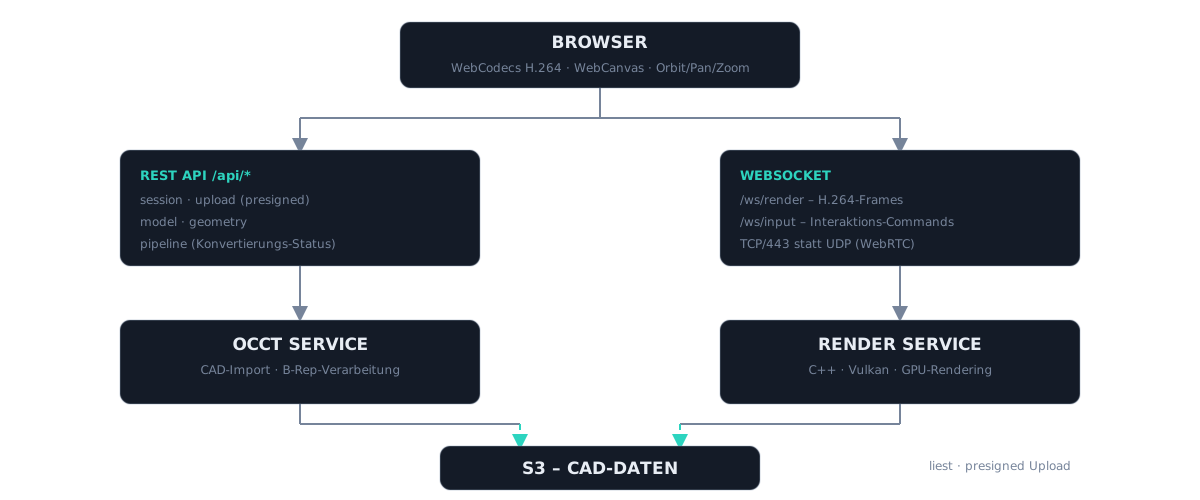
- CAD geometry is processed server-side (OCCT) and rendered with C++/Vulkan on dedicated GPUs. The browser receives only an H.264 video stream via WebSocket plus metadata for UI overlays, and sends interaction commands back.
- Engineering challenges
- Low-latency interaction over websockets, consistent rendering independent of client hardware, processing large volumes of CAD data and transport over private networks without public IPs (WebSocket instead of UDP/WebRTC).
- Demonstrated capabilities
- GPU computing and Vulkan rendering, CAD import via OCCT, C/C++ performance engineering, H.264 streaming via WebSocket/WebCodecs and cloud/GPU infrastructure.
Voluqon is a Riegel Systems engineering case in the field of high performance engineering. Complex CAD and engineering data typically exceeds the capabilities of end devices – and for many use cases it is critical that the CAD geometry does not leave the backend.
Approach
Instead of burdening the browser with the complete data model, processing is carried out server-side on GPU-capable hardware:
- CAD data is imported and prepared server-side via OCCT (OpenCascade)
- Rendering is done with C++ and Vulkan on dedicated GPUs
- The browser receives only an H.264 video stream plus metadata for UI overlays
- Interactions are transmitted with low latency via websockets
Transport decision
Instead of WebRTC, WebSocket over TCP/443 is used: the target environment uses private subnets without public IPs, and TCP also passes restrictive firewalls and load balancers that block UDP. The browser decodes the H.264 frames with the WebCodecs API and draws them onto a canvas.
Technical aspects
- CAD Data Processing (OCCT)
- GPU Rendering (Vulkan)
- H.264 Encoding
- Streaming (WebSocket)
- Browser Interaction (WebCodecs)
Insights
The case shows how to resolve the “local hardware” bottleneck through a clean server-client separation: compute-intensive paths run where the performance is, while the browser primarily handles display and interaction – and the underlying data stays securely in the backend.
Technologies & concepts
A similar engineering project?
If your project needs comparable technical depth, we discuss feasibility, architecture and effort – concretely rather than in pitch format.